
Global supply chains are under more pressure than ever. Organizations must operate efficiently, respond to disruptions quickly, and keep costs under control while customer expectations continue to rise. To achieve this, companies are increasingly turning to modern supply chain management (SCM) solutions powered by cloud computing, artificial intelligence, real-time data, and automation.
Microsoft has emerged as a leader in this space, offering an integrated ecosystem of tools that transform traditional supply chains into intelligent, connected, and resilient networks. In this article, we explore:
- What supply chain management really means
- How Industry 4.0 is reshaping the supply chain
- How to choose the right SCM solution
- Why Microsoft Dynamics 365 Supply Chain Management stands out
- How Power Platform enhances supply chain operations
- How Copilot brings AI to supply chain management
Introduction to Supply Chain Management
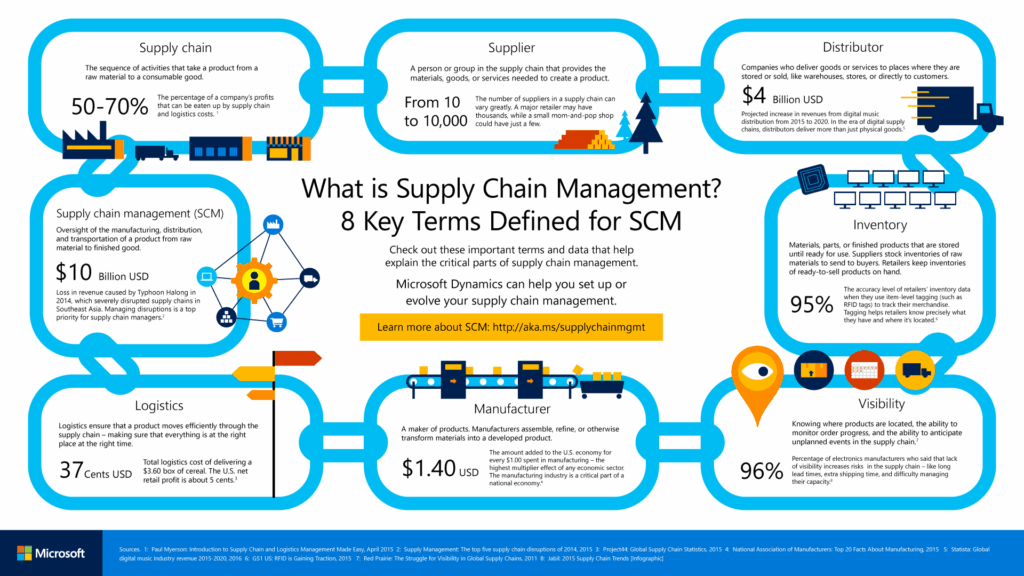
Supply chain management (SCM) refers to the coordination of the flow of goods, information, and financial resources from raw material sourcing all the way to final product delivery. While many people associate SCM only with logistics, logistics is just one component of a much broader system.
A modern supply chain includes:
- Procurement and supplier management
- Product lifecycle management
- Inventory and asset management
- Production and manufacturing
- Logistics and transportation management
- Order and distribution management
- Global trade and compliance
Today, SCM is powered by digital systems capable of integrating information from suppliers, manufacturers, distributors, logistics providers, and retailers. These tools enable companies to optimize operations, reduce risks, and maintain end-to-end visibility across every stage of the value chain.
Industry 4.0 and the New Era of Supply Chain Management
The fourth industrial revolution — often referred to as Industry 4.0 — is transforming how products are designed, produced, and delivered. Technologies such as:
- Artificial intelligence
- Machine learning
- Internet of Things (IoT)
- Automation
- Sensors
- Predictive analytics
are enabling companies not just to react to problems, but to anticipate and prevent them.
Where companies once waited for machines to break down before repairing them, predictive maintenance now identifies failures in advance. Where demand planning once relied on spreadsheets and estimates, AI now uses real-time data to forecast customer needs with much higher accuracy.
This evolution delivers major advantages:
- aligned planning and execution
- cost reduction
- lower risk of stockouts or overproduction
- improved agility and resilience
- elimination of repetitive manual tasks
Industry 4.0 is, in many ways, built on the supply chain — and the supply chain is becoming smarter because of it.
Why the Cloud Is Transforming Supply Chain Management
Cloud technology is a natural foundation for modern supply chains. Unlike traditional on-premises systems, cloud platforms are:
- flexible
- scalable
- easier to update
- faster to integrate
They support real-time data visibility, enable rapid deployment of new capabilities, and simplify collaboration among distributed teams and locations.
With the cloud, organizations can:
- adopt modules incrementally instead of full migration at once
- integrate AI and IoT technologies seamlessly
- access supply chain tools from any device, anywhere
- scale operations as business grows
This makes the cloud an essential ally in facing constant market changes, disruptions, and evolving customer expectations.
How to Choose the Right Supply Chain Management Solution
Selecting the right SCM solution requires more than simply comparing software features. Companies must evaluate:
- compatibility with existing processes
- scalability for future growth
- ease of integration with ERP/CRM systems
- flexibility to adapt as business evolves
- AI-enabled forecasting and analytics
- security and data protection
Large vendors like Microsoft, SAP, and Oracle provide full ecosystems where SCM modules integrate deeply with enterprise resource planning (ERP) and finance tools. This level of integration is essential for organizations with complex, global operations.
The key is to assess:
- current pain points
- manual or paper-based processes
- budget
- operational complexity
From there, companies can determine the right mix of supply chain applications.
Dynamics 365 Supply Chain Management: Microsoft’s Flagship Solution
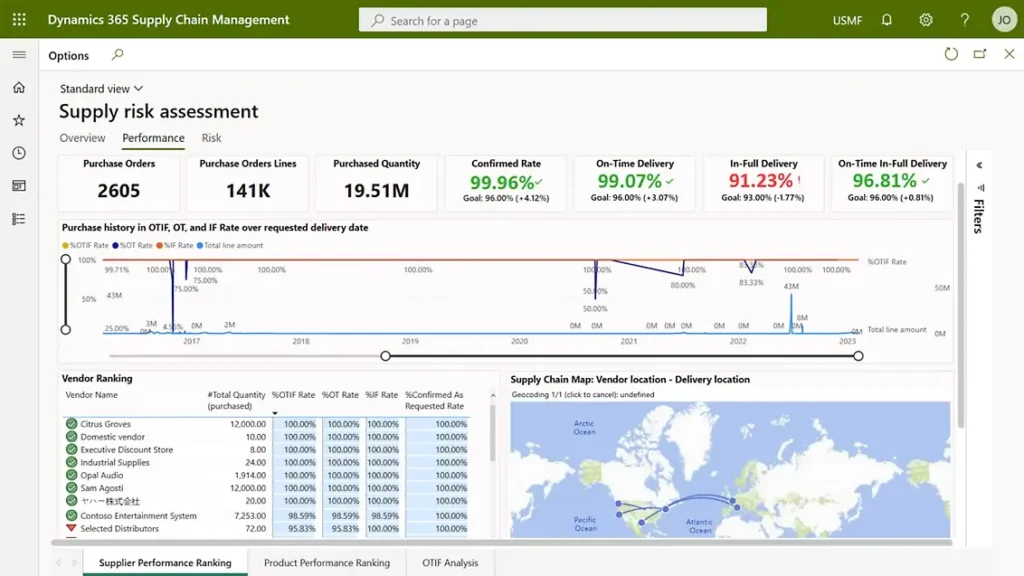
Microsoft Dynamics 365 Supply Chain Management (SCM) is designed to optimize planning, production, warehouse operations, and order fulfillment. It delivers a real-time, end-to-end view of the supply chain, enabling leaders to make informed and proactive decisions.
Dynamics 365 SCM supports:
- AI-based demand forecasting
- production scheduling
- warehouse automation
- order orchestration
- cost and profitability tracking
It can be deployed in the cloud or on-premises, and it is accessible from desktops, tablets, and smartphones — making it suitable for organizations with multiple locations, languages, and high transaction volumes.
Key capabilities of Dynamics 365 SCM include:
- Scalable configuration models: automatically generate BOMs and routes
- Production planning workspaces: visualize schedules with dashboards and Gantt charts
- Advanced costing and forecasting: understand true material and overhead costs
- Production control: manage shop-floor jobs in real time
- Custom reporting: transform operational data into actionable insights
- Distributed order management: balance fulfillment, quality, and profitability
- Supplier collaboration tools: streamline communication and transactions
- Integration with Power BI: unlock deep analytics and performance monitoring
Together, these capabilities empower companies to build efficient, resilient, and transparent supply chains.
Enhancing SCM with Microsoft Power Platform
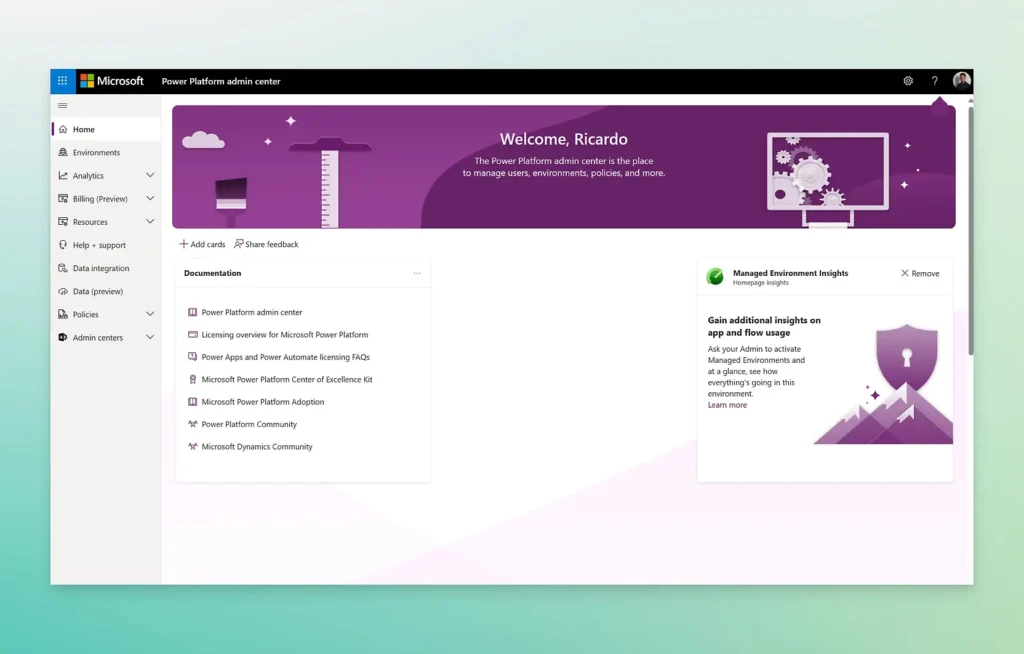
Beyond Dynamics 365 SCM, Microsoft offers a complementary suite — Power Platform — which accelerates digital transformation and enables automation without heavy coding.
Power Platform consists of:
- Power Apps
- Power Automate
- Power BI
Power Apps: build custom supply chain apps
With Power Apps, companies can create tailored applications for:
- inventory tracking
- order monitoring
- equipment inspections
- material traceability
all without advanced programming skills. This reduces development costs and enables faster innovation inside supply chain operations.
Power Automate: streamline workflows
Power Automate enables organizations to:
- automate stock replenishment
- send alerts for shipment delays
- synchronize data between systems
- trigger approval processes
This reduces manual effort and prevents errors caused by repetitive data handling.
Power BI: transform data into insight
Power BI helps businesses:
- visualize performance dashboards
- detect bottlenecks
- analyze trends
- forecast demand
- measure supplier performance
By bringing together data from multiple sources, Power BI turns information into strategic decision-making power.
Copilot for Dynamics 365: AI for the Modern Supply Chain
Microsoft Copilot brings generative AI directly into Dynamics 365 applications. For supply chain teams, this means:
- conversational interaction with data
- instant answers to operational questions
- automated report generation
- risk assessment and scenario simulation
Copilot helps users:
- evaluate supplier risks
- understand demand variations
- predict the impact of procurement changes
- receive proactive recommendations
As this technology evolves, Copilot will increasingly transition from answering questions to suggesting optimized actions — transforming how supply chain professionals work every day.
Why Microsoft Supply Chain Solutions Stand Out
Microsoft’s supply chain ecosystem is powerful because it is:
- integrated (ERP + CRM + analytics + AI)
- scalable for any size of organization
- cloud-enabled yet flexible for hybrid or on-premises needs
- built with strong security and compliance foundations
- supported by Azure’s global infrastructure
Organizations benefit from a unified platform rather than disconnected tools — improving collaboration across procurement, finance, operations, logistics, and customer service.
Twenty years ago, complete visibility and control across the entire supply chain felt like an impossible ambition. Today, thanks to Industry 4.0 and cloud technologies, it is not just possible — it is becoming essential.
With Microsoft supply chain solutions, businesses can:
- automate manual processes
- predict disruptions and demand shifts
- integrate AI for smarter decisions
- improve operational efficiency
- enhance resilience and agility
In a world defined by uncertainty and rapid change, the companies that win will be those who build intelligent, connected, data-driven supply chains — and Microsoft provides one of the most comprehensive platforms to make that transformation real.
Frequently Asked Questions
What is supply chain management (SCM)?
SCM is the coordination of goods, information, and financial flows from sourcing raw materials to delivering the final product to the customer.
How does SCM differ from logistics?
Logistics focuses on transportation and distribution, while SCM encompasses procurement, production, inventory, collaboration, and end-to-end value creation.
Why use digital supply chain solutions?
They increase efficiency, reduce costs, improve visibility, and enable real-time, data-driven decision-making.
What role does Industry 4.0 play in SCM?
It introduces AI, IoT, predictive analytics, and automation to transform reactive processes into proactive ones.
Why is the cloud important in SCM?
It enables flexibility, scalability, rapid integration of new technologies, and easier collaboration.
How do you choose the right SCM solution?
Evaluate adaptability, integration, scalability, AI capabilities, security, and alignment with existing processes and budget.
What Microsoft solutions support supply chain management?
Dynamics 365 Supply Chain Management, Power Platform (Power Apps, Automate, BI), and Copilot AI.