


Supply Chain Management System in Kenya.
In Kenya’s rapidly evolving manufacturing sector, operational momentum is a competitive advantage. Every stage—procurement, production, warehousing, logistics, and delivery—depends on synchronized workflows. Yet many Kenyan manufacturers struggle with delays, inaccurate forecasts, and fragmented systems that force teams to react instead of plan.
The result?
Hidden costs, shrinking margins, and constant firefighting.
This happens not because organizations lack technology, but because their systems don’t communicate.
This is where the Microsoft Dynamics 365 Supply Chain Management System in Kenya becomes a game-changer. It doesn’t function as just another tool—it becomes the digital backbone that powers end-to-end visibility, intelligent workflows, and true operational flow.
At Software Dynamics, we help manufacturers build this momentum—designing integrated ERP ecosystems that connect data, eliminate bottlenecks, and enable continuous movement from procurement to production to delivery.
Supply Chain Constraints Facing Kenyan Manufacturers
Kenyan manufacturers face a unique mix of local and global challenges. Rising input costs, foreign exchange volatility, port congestion, and supply disruptions are constant realities. But the most damaging inefficiencies often occur internally.
Common constraints include:
- Manual workflows that slow production planning and approvals
- Siloed systems, leading to duplicated data and errors
- Limited visibility across inventory, suppliers, and production
- Delayed financial reporting, making it hard to respond in real time
- Fragmented communication between departments
Research from the International Finance Corporation (IFC) shows that African manufacturers lose up to 30% of productive efficiency due to poor supply chain synchronization.
In other words: inefficiency is expensive.
These constraints don’t just hurt operations—they limit scalability, increase working capital requirements, and reduce competitiveness in a fast-moving marketplace.
How Microsoft Dynamics 365 Supply Chain Management System in Kenya Redefines Flow
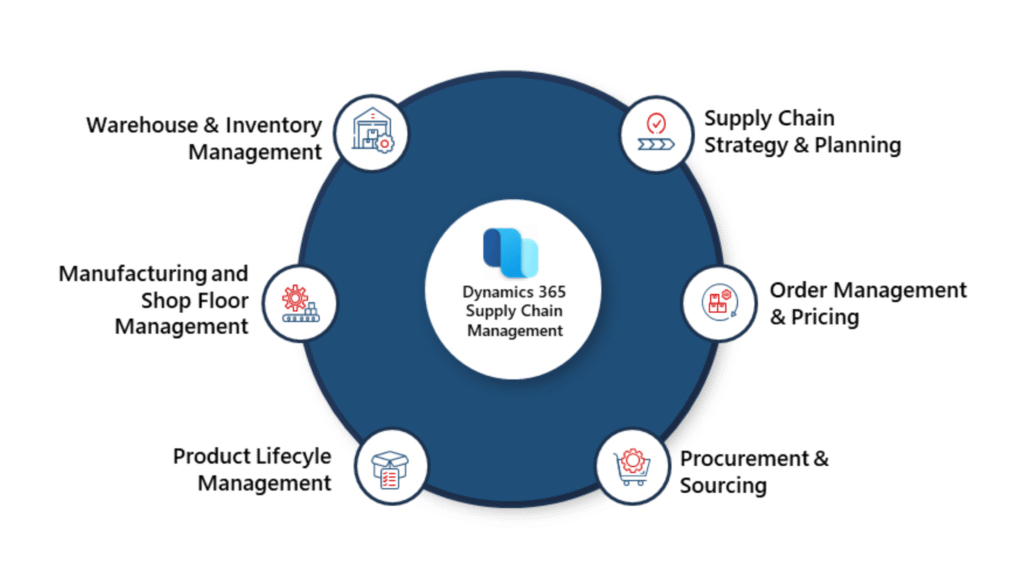
A modern ERP is more than a database. It’s an intelligent, adaptive platform that aligns your entire supply chain into one synchronized system.
Microsoft Dynamics 365 Supply Chain Management offers manufacturers:
✔ End-to-End Visibility
Track inventory levels, supplier performance, production status, and delivery progress in real time.
✔ Predictive Demand Forecasting
Use advanced analytics to optimize production planning and reduce stockouts or overproduction.
✔ Integrated Financial Insights
See true production costs, margins, and working capital needs directly within operational workflows.
✔ Automated Workflows and Alerts
Minimize manual intervention by automating purchase approvals, reorder triggers, quality checks, and delivery notifications.
✔ Connected Operations
Unify procurement, warehousing, production, distribution, and finance into one intelligent ecosystem.
Instead of reacting to problems, Kenyan manufacturers using Dynamics 365 SCM operate with proactive intelligence—adapting automatically to market changes and supply chain variability.
From Reactive to Predictive: The Strategic Edge for Kenyan Manufacturers
Traditional ERP systems help record transactions. But Dynamics 365 helps manufacturers predict, respond, and optimize.
With real-time data and AI-driven insights, manufacturers can:
- Align production with accurate demand forecasts
- Detect supplier risks before they impact operations
- Optimize inventory to balance cost and availability
- Improve order accuracy and customer satisfaction
- Run simulations to prepare for disruptions
The Microsoft Dynamics 365 Supply Chain Management System in Kenya transforms ERP from a reporting tool into a strategic decision engine—one that continuously learns and adapts.
This is operational momentum designed through data clarity.
Why Microsoft Dynamics 365 SCM Matters in Kenya’s Manufacturing Sector
Kenya Vision 2030 and national industrialization strategies highlight digital transformation as key to manufacturing competitiveness. But with rising complexities in logistics, compliance, and regional trade, traditional systems are no longer enough.
Kenyan manufacturers need:
- Localized tax and compliance support
- Faster decision-making
- Real-time supply chain visibility
- Integration across multi-site operations
- Automation to reduce manual bottlenecks
- Mobile-first accessibility for distributed teams
The Microsoft Dynamics 365 Supply Chain Management System in Kenya aligns global best practices with local operational realities. Software Dynamics has spent over 15 years building, customizing, and deploying ERP solutions tailored to the African market.
Implementation Excellence – Engineering Continuous Momentum
A successful ERP implementation is not merely a system upgrade—it is a redesign of operational rhythm.
Software Dynamics applies the Momentum Implementation Framework, ensuring predictable outcomes and measurable value:
The Software Dynamics Momentum Framework
1. Assess
Identify bottlenecks, data silos, and process inefficiencies.
2. Design
Build a unified Dynamics 365 architecture aligned with business goals.
3. Integrate
Connect procurement, production, logistics, warehousing, and finance.
4. Optimize
Automate workflows, establish KPIs, and enable predictive analytics.
5. Evolve
Continuously improve the ERP ecosystem using real-time insights.
Momentum isn’t installed—it’s engineered.
The ROI of Supply Chain Momentum
Organizations implementing the Microsoft Dynamics 365 Supply Chain Management System in Kenya often report:
- 20% reduction in carrying costs
- 30–40% faster production planning cycles
- Higher on-time delivery performance
- Lower stockouts and overstock
- Improved cross-departmental collaboration
- Greater forecasting accuracy
These results come not from technology alone, but from creating a connected, data-driven operation where decisions are faster, smarter, and more aligned.
Conclusion – Designing the Future of Movement
The future of manufacturing in Kenya won’t be defined by who can produce the most—it will be defined by who can move the smartest.
When operations, data, partners, and decisions are connected through Microsoft Dynamics 365 Supply Chain Management, manufacturers gain the foresight and flexibility needed to thrive in an unpredictable market.
At Software Dynamics, we don’t just implement ERP systems.
We design motion—transforming fragmented processes into synchronized ecosystems of progress.
Because the future belongs to organizations that can move.
Request Your Microsoft Dynamics 365 SCM Demo Today.
Fill in the form to explore ERP-driven efficiency for your manufacturing operations.